

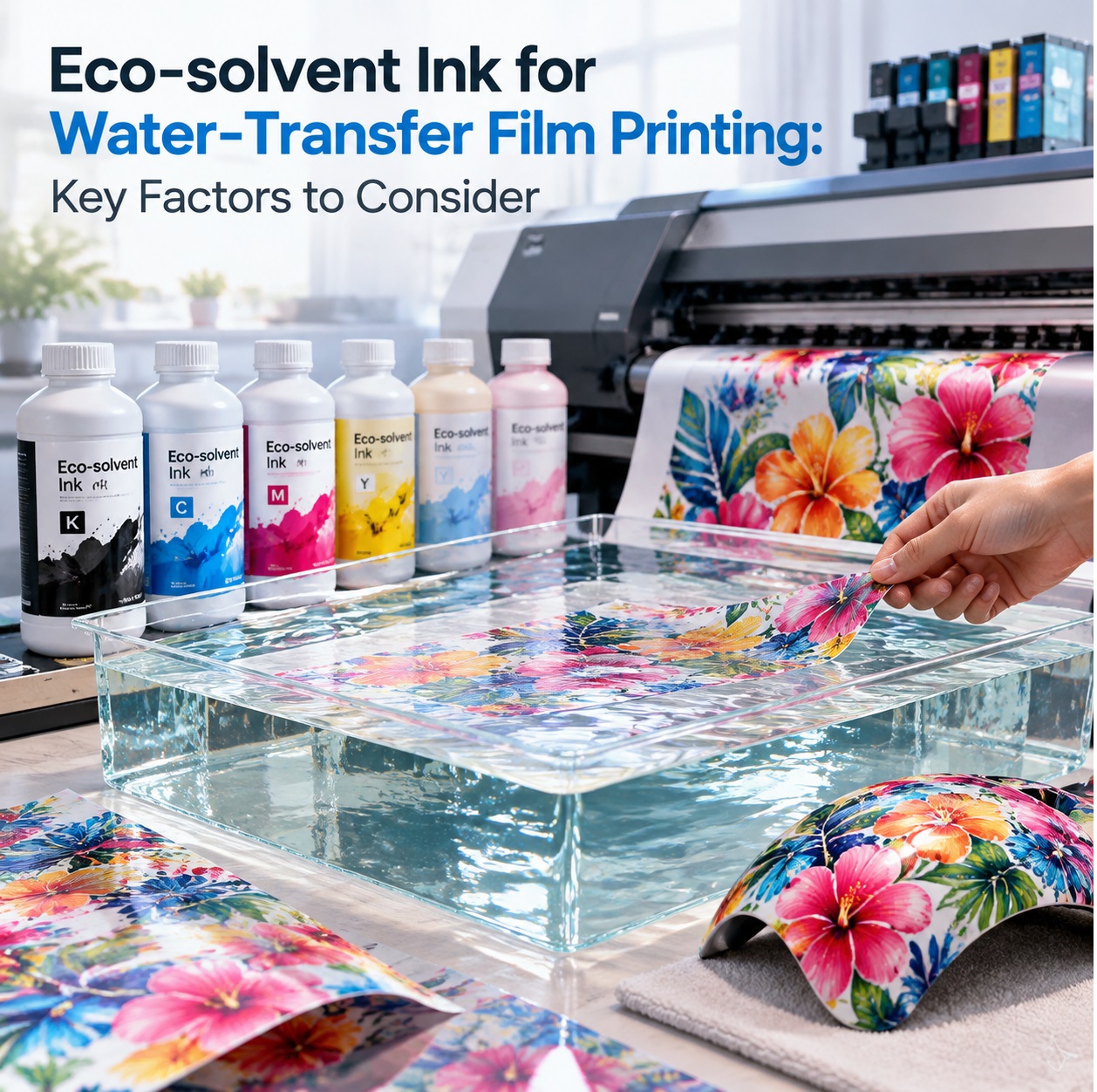
 Most water-transfer film failures don’t announce themselves at the printer. They show up in the water bath, three seconds before the decal wrinkles, tears, or refuses to slide off its backing. By then the ink has been paid for, the film has been paid for, and the labor is gone.
If you’re printing water-transfer film with eco-solvent ink, the ink is only half the equation. The other half is everything the ink touches, and how those things behave together under heat, water, and stretching.
Start with the film itself. Water-transfer film isn’t one product. Coatings differ wildly depending on whether the film was engineered for laser toner, screen printing, UV-curable ink, or solvent-based digital. A film that performs beautifully with UV ink can behave like a sponge with eco-solvent, drinking up solvent and swelling in ways that ruin registration. Ask your film supplier for a compatibility sheet, then ignore half of it and run your own test anyway. Coating batches vary more than anyone in this industry likes to admit.
Printhead compatibility deserves its own conversation. Eco-solvent is a mild solvent, but mild still means aggressive if your machine was built for water-based ink. Epson DX series, Ricoh Gen5, Kyocera KJ4 heads all have different tolerances. Check not just the head but the ink lines, dampers, capping station, and wiper assembly. Retrofitting a water-based printer to run eco-solvent is a reliable way to spend your money twice.
Pigment load and viscosity matter more on film than on paper. You want strong optical density from a relatively thin ink layer, because thick films crack when they flex. High pigment concentration with a well-tuned viscosity gives you color that survives the transfer without building a brittle crust.
Elongation is the number most people overlook. When you slide a decal onto a curved surface and work it into place, the film stretches. The ink has to stretch with it. Ask for elongation data, then do the pen test: wrap a cured print around a pen or a bottle neck and look for hairline cracks. If it cracks there, it will crack on a helmet, a bike frame, or a curved glass panel.
The drying and curing window is narrower than you’d expect. Eco-solvent needs heat to flash off solvent and set the resin, but water-transfer film is thin, sometimes fifty to a hundred microns. Too little heat and you get smearing and poor adhesion. Too much and the film curls, shrinks, or wrinkles before it ever hits the water. Shops discover this the hard way when summer humidity shifts and their usual platen temperature suddenly isn’t working anymore.
White ink is the backbone of most water-transfer work. If you’re printing on clear film for dark or colored substrates, everything depends on that white layer being opaque, smooth, and consistent. White pigment is heavy. It settles. It clogs. Circulation systems, daily agitation, and a real maintenance schedule aren’t optional extras here, they’re the price of admission. Test opacity on black, not on a white proof sheet, because some whites look perfectly white until you actually put them somewhere that matters.
Release behavior is a film-and-ink interaction, not a setting you can fix later. The printed layer has to release from the carrier at the right moment. Too much adhesion and the decal tears as you slide it. Too little and it floats off before you can position it. This is where a mismatched ink and film combination becomes obvious, and no amount of tweaking in the RIP will save it.
Topcoat and activator compatibility catches people off guard too. Many water-transfer applications need a clear coat, an activator spray, or a lacquer to lock the graphic down. Some eco-solvent inks react badly to those chemistries, wrinkling, hazing, or shifting color. Always test the full stack, not just the print.
Color consistency across batches deserves real attention. Matching Pantone on film is harder than on paper because the substrate is transparent and the final appearance depends on what’s underneath. Build your own ICC profile on the actual film you’re using, not on a paper proxy that only approximates the surface.
Compliance and odor still matter even with the word “eco” in the name. Eco-solvent is eco relative to full solvent, not zero-VOC. If you’re running a small shop, ventilation and air quality affect your people and your insurance. Buyers in toys, food-contact, and medical categories will ask for documentation, and having it ready saves weeks.
Cost per print beats cost per liter every time. The useful number is yield: square meters per cartridge at your actual coverage, waste from clogs and reprints, purge cycles, and how often you replace a printhead. A cheap ink that kills a head is the most expensive ink you can buy.
Finally, look hard at supplier support. Do they provide ICC profiles for your specific printer and film combination? Do they answer the phone when your white ink separates on a Friday afternoon? That’s where brands actually differentiate, and it almost never shows up on a spec sheet.
A simple test protocol will save you a lot of grief: print a target, cure it for twenty-four hours, soak it, slide it, apply it, wait a day, then tape test and bend test. If it survives all of that, run a hundred. If it doesn’t, don’t try to rescue it with a heat setting. Choose the ink and film as a pair, test like you trust nobody, and buy from someone who picks up the phone